What Are Canopic Jars and Why Were They Used in Ancient Egypt?
What Are Canopic Containers?
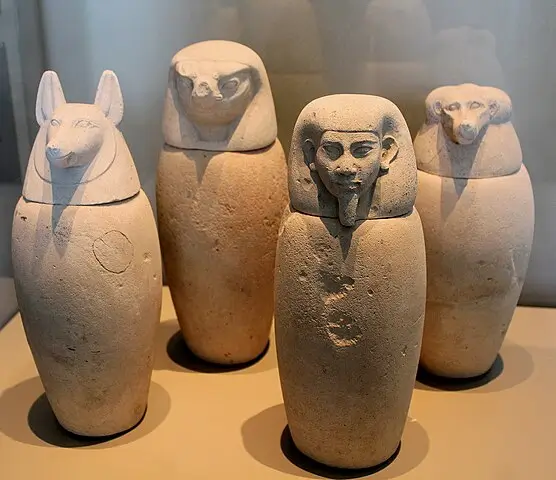
The Deities Associated with the Four Main Organs
| Topic | Quick Answer | Why it mattered |
|---|---|---|
| What “canopic” means | A group of containers for organs removed during mummification. | Protecting organs was part of preserving identity and ensuring renewal. |
| Main contents | Liver, lungs, stomach, intestines. | Organs were treated as vulnerable and needed divine protection. |
| Where the heart went | Usually left inside the body. | The heart mattered for identity and judgment in the afterlife. |
| The Sons of Horus | Four protectors linked to the four organs. | They transform anatomy into a sacred “protected set.” |
| How lids evolved | Flat → human heads → animal/bird heads for three sons. | Visual theology: the jar becomes a divine person, not just a container. |
| Peak “classic” set | Middle Kingdom → New Kingdom standardized equipment. | Box + jars + texts create a complete protective system. |
| Later symbolic use | Organs often returned to the body; jars continued as ritual symbols. | A strong example of tradition outliving its original function. |
The Origins of Canopic Products
The earliest canopic products placed bundles of dried and wrapped entrails directly into a specially constructed box or cavity in the wall. Although such canopic niches are found at Saqqara in Second Dynasty tombs, the first clear examples date to the Fourth Dynasty (ca. 2649-2609 BCE), where a number of tombs at Meidum contain niches whose size and location (which match later canopic use) indicate that they were canopic boxes. A real box was provided for Sneferu’s wife, carved from a block of Egyptian alabaster and divided into four square compartments, each containing a block that was almost certainly part of her internal organs soaked in a solution of natron.
Canopic Practices During the Fourth Dynasty
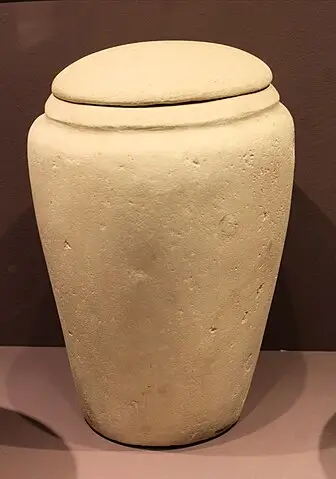
Date: 11 June 2019, Source: Own work, Author: Dguendel
Materials and Innovations in Canopic Jars During the Early Medieval Period
Evolution of Canopic Furnishings by the Middle and New Kingdoms
By the end of the Middle Kingdom, a basic idealized model for canopic furnishings was reached. The outer stone box mirrored the design of the sarcophagus; the inner box, made of wood, mirrored the design of the sarcophagus. The texts of the wooden box summoned each of the four dominant deities to wrap their protective arms around the designated section and proclaim the deceased’s honor before them. Inside the wooden box were four human-lidded urns, one for each part, with texts repeating the sentiments expressed on the box. A typical example of such a text, from the Canopic Imseti (liver) urn of King Hor Awibre of the Thirteenth Dynasty, reads Isis, extend your protection about Imsety who is in you, O honoured before Imsety, the King of Upper and Lower Egypt, Awibre [Hor]. Not all burials conform to this idealized model, but the existence of a pattern of canopic urns and boxes is confirmed by the appearance of painted images of urns complete with texts on the inner lid of one box whose size showed that it contained only simple bundles of viscera – the box of King Sobekemsaf II.
Changes in Canopic Practices from the Seventeenth to the Eighteenth Dynasties
| Deity | Organ | Protective Goddess | Typical Head (later lids) |
|---|---|---|---|
| Imsety | Liver | Isis | Human |
| Hapy | Lungs | Nephthys | Baboon |
| Duamutef | Stomach | Neith | Jackal |
| Qebehsenuef | Intestines | Selket | Falcon |
Innovations in Royal Canopic Equipment from the Eighteenth Dynasty Onwards
Changes in Canopic Practices During the Nineteenth and Twentieth Dynasties
The royal calcite boxes changed during the reign of Merneptah (r. 1237-1226 BC), no longer displaying corner deities; they were replaced by four separate urns in the early 20th Dynasty. It is unclear how the urns were placed, but they do not appear to have been placed in a stone box. The only extant royal example is that of Ramses IV (r. 1166-1160 BC).
The Evolution of Canopic Equipment from the Early 21st Dynasty
Beginning in the early 21st Dynasty, most mummies were gutted and returned to the body cavity after mummification. Nevertheless, the canopic urn became so essential to funerary attire that high-status individuals continued to use it even when empty. By the Twenty-second Dynasty, they were replaced by solid canopic urns, and a clear example of the triumph of form over function was achieved when mock viscera containers were placed inside the silver canopic sarcophagi of Shoshenq II (ca. 910 BCE).
Twenty-first Dynasty urns generally followed the prototypes in their Middle Kingdom and New Kingdom counterparts. In contrast, texts on urns from the 22nd to 23rd Dynasties tended to be fairly simple, often resorting to the minimalist approach of simply naming the deceased person. The form varied greatly, as did the decoration, which was often brightly colored polychrome during the Twenty-third Dynasty. Although uncommon, canopic equipment is found in a minority of the burials of the Third Intermediate Period. Canopic urns were often placed inside naos-shaped boxes, albeit decorated in different ways than in the New Kingdom; around the beginning of the Third Intermediate Period, a jackal in the form of Anubis was mounted on the lid of the box. Kings generally had wooden canopic boxes, with the exception of Shoshenq I, who had a calcite box.
Adaptations in Canopic Jars and Boxes During the Saite Period
- Canopic equipment wasn’t “storage” only — it was a protective system tied to divine guardianship.
- The four organs became a sacred set, mapped to the Sons of Horus and their protective goddesses.
- Lid designs show theology in motion: jars shift from human identity to divine personifications.
- From the Middle Kingdom to the New Kingdom, canopic boxes and texts often mirrored coffin design.
- Later periods kept the jars even when organs were returned to the body — tradition became the function.
FAQ: Canopic Jars in Ancient Egypt
What are canopic jars?
They are ritual containers used to protect organs removed during mummification, often placed inside a canopic box.
Which organs were stored in canopic jars?
Most commonly the liver, lungs, stomach, and intestines were preserved separately.
Why was the heart usually left inside the body?
Because the heart was treated as central to identity and later ideas of judgment in the afterlife.
Who are the Four Sons of Horus?
They are protective deities assigned to guard specific organs, commonly paired with four goddesses for protection.
Why do canopic lids show different heads?
Over time, lids shifted from simple forms to iconography that visually identifies the protector deities.
Did everyone in Egypt use canopic jars?
No. Canopic equipment is most common in higher-status burials, while simpler burials used cheaper alternatives or none at all.
Why did canopic jars continue even when organs were put back in the body?
Because the jars became a required funerary symbol — a ritual form that signaled protection, even if empty.
When did canopic equipment disappear?
It seems to fade out before the end of the Ptolemaic period, replaced by other funerary conventions.
Sources & Rights
- Taylor, John H. Death and the Afterlife in Ancient Egypt. British Museum Press.
- Ikram, Salima. Death and Burial in Ancient Egypt. Longman.
- Dodson, Aidan. The Canopic Equipment of the Kings of Egypt. (Scholarly study of royal canopic sets.)
- Shaw, Ian (ed.). The Oxford History of Ancient Egypt. Oxford University Press.
- The Metropolitan Museum of Art. Collection entries on canopic jars and the Sons of Horus (museum documentation).